Why Continuous Insulation Makes a Home More Comfortable
When you picture an energy-efficient wall, you probably think about the insulation tucked between its studs. That insulation matters, but the framing around it matters too. Heat can move through studs, headers, and other structural connections, reducing the performance of the wall as a whole. Continuous insulation helps address those paths, supporting a home that is easier to keep comfortable throughout the year. Following our recent look at roof overhangs and exterior shading, this week we are moving into the walls themselves. For anyone planning a home in Asheville, Lake Lure, or the surrounding mountains, understanding how insulation fits together can lead to better questions during design.
What is a thermal bridge
A thermal bridge is a path through the building enclosure where heat flows more readily than through the surrounding insulated areas. In a wood-framed wall, studs interrupt the insulation between them. Wood provides structural support, but it resists heat flow less effectively than the insulation beside it. Metal connections can also create thermal bridges.
This explains why the R-value printed on a bag of insulation does not describe the performance of the entire finished wall. The framing, installation quality, and connections all influence the result. A wall with well-insulated cavities can still lose heat through the structure that holds those cavities together.
How continuous insulation helps
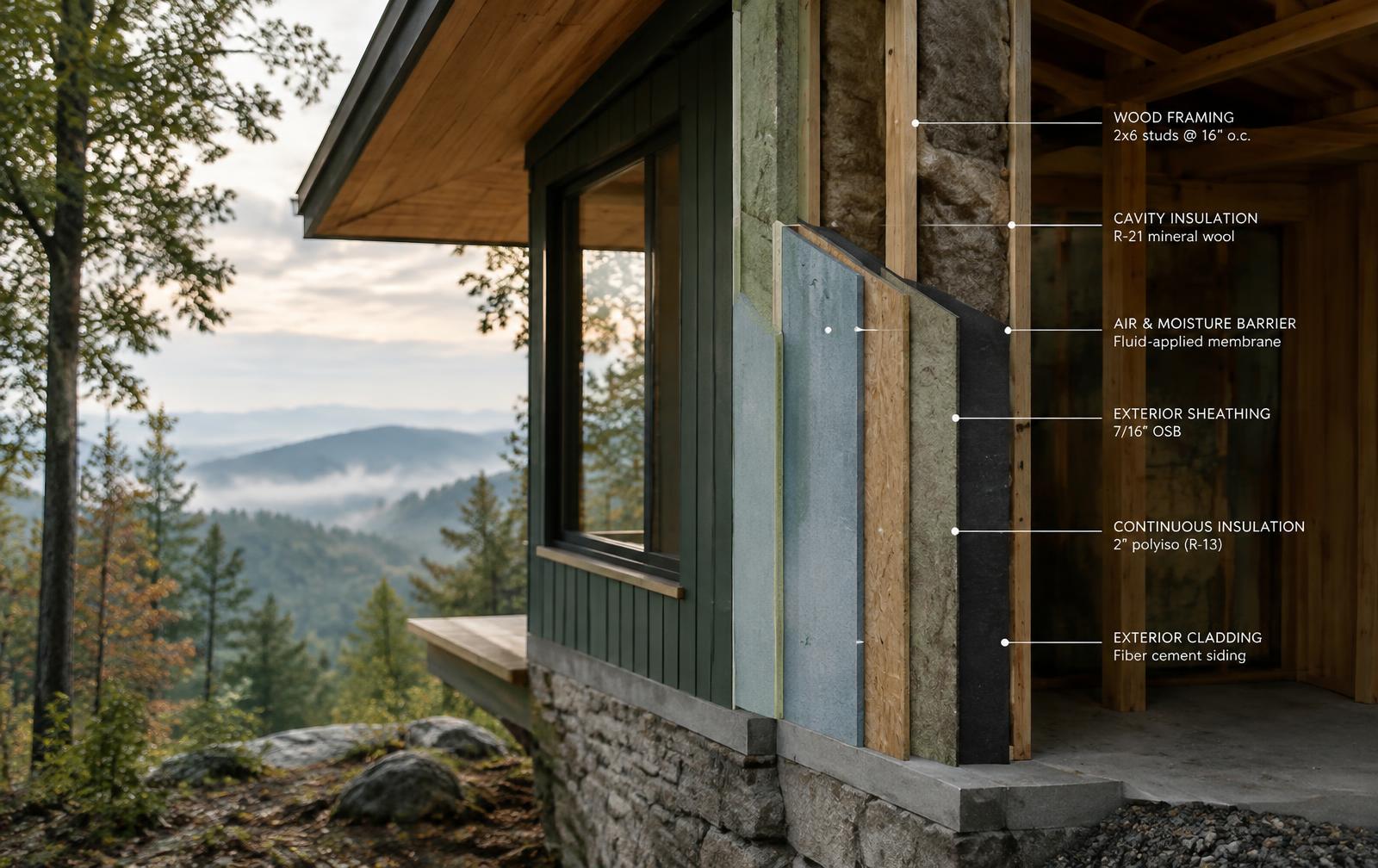
Continuous insulation extends across the framing, often on the outside of the wall sheathing. Instead of stopping at each stud, this additional layer covers much of the structure and reduces the heat flow through it. Exterior insulation can be made from different materials, including rigid foam and mineral wool boards designed for that application.
Continuity also depends on details. Window openings, wall corners, roof connections, and foundation transitions deserve attention because a thermal layer is only as effective as its connections. Cladding supports and fasteners must be designed for the assembly as well.
Comfort you can feel
During cold weather, a better-insulated wall can help keep its interior surface warmer. Surface temperature affects how comfortable you feel beside that wall, even when the thermostat shows a familiar setting. Reducing heat transfer can also reduce heating and cooling demand, although the savings depend on the complete building and how it is operated.
For homeowners, these details matter in ordinary moments: sitting beside an exterior wall, arranging furniture in a bedroom, or choosing where to place a reading chair. Comfort deserves a place in the design conversation alongside views, finishes, and floor plans.
Moisture control is part of the design
Exterior insulation can help keep wall sheathing warmer during winter and reduce condensation risk. Its thickness must be coordinated with the insulation inside the wall, the local climate, and the materials that control vapor movement. The wall also needs a suitable drying path.
Insulation does not replace flashing, drainage, or air sealing. A successful assembly manages rainwater, air movement, heat flow, and water vapor together. Those layers may serve different functions, even when one product performs more than one role.
Questions to ask before construction
Ask your builder how the proposed wall performs as a complete assembly. Where does the insulation continue past the floor edge? How will it connect to the roof and foundation? How are windows flashed and supported? Which layer controls air leakage, and how will that layer be checked? Clear details make these questions easier to answer before the walls are closed.
Planning a comfortable mountain home
At Arbor Stone Homes, we see building-science decisions as part of creating a home that feels good to live in. Continuous insulation is one tool for connecting architectural design with everyday comfort. Its value comes from choosing an appropriate assembly and carrying that design carefully through construction.
Planning a home in Western North Carolina? Visit arborstonehomes.com to start a conversation about your site, your priorities, and the enclosure details that can support them.
Further reading
If you'd like to dig deeper into the building science behind continuous insulation and moisture control, these resources are a good place to start: